How we work
Supplement Review Editorial Standards at the Synaptril Label Desk
Our supplement review editorial standards are the rules the Synaptril label desk follows on every page: start from the printed label, use public health and research sources, grade evidence plainly, show blend math instead of guessing doses, publish no unverified reviews, and say openly that we earn money from order links.
Written by the Synaptril label deskUpdated
The short version01
What are our supplement review editorial standards?
Our supplement review editorial standards are a short set of rules for writing about Synaptril. The label comes first, every health claim needs a public source, and nothing is made up.
Pages are written by the Synaptril label desk at Getsynaptril, a stocked U.S. Synaptril counter. We are not the manufacturer or the distributor, so we have no secret recipe sheet. We read the same bottle you can read.
- Every fact about the capsule comes from the label or the sales page.
- Every health statement links to a named source you can open.
- Hidden blend amounts are shown as limits, never as exact numbers.
- No rating, review count or customer quote appears until it is verified.
Sources02
How do we choose sources for supplement articles?
We choose sources by how close they sit to the facts. The bottle is first, government health agencies come next, then medical centers and published reviews.
Agency pages from the NIH Office of Dietary Supplements, NCCIH, FDA and CDC are our default for safety and dose facts. They are written for the public and free to read.
A single trial gets cited only with its size and limits, such as the curcumin study of 46 adults (Small 2018, Curcumin memory RCT). A chemistry estimate, like the magnesium share of magnesium glycinate (Magnesium glycinate, Mg content), is always called an estimate.
| Tier | Source | Used for |
|---|---|---|
| 1 | The printed label and Supplement Facts panel | Ingredients, order, magnesium, directions, warnings |
| 2 | The sales page, read on a stated date (Synaptril sales page) | Prices, packs, shipping, guarantee |
| 3 | NIH ODS, NCCIH, FDA, CDC, FTC | Safety, interactions, rules, habits |
| 4 | Medical center herb guides, Cochrane reviews | Ingredient evidence, side effects |
| 5 | Single trials, chemistry estimates | Context only, with limits stated |
Evidence03
How do we grade ingredient evidence?
We grade ingredient evidence in four plain steps, from "no human trials" to "consistent trials in people". The grade describes the ingredient in studies, not the Synaptril capsule.
No trial has tested Synaptril itself. So every grade comes with a second question: is the studied dose anywhere near what one capsule can hold?
A Cochrane search found no qualifying trials of alpha lipoic acid for dementia (Cochrane, Alpha-lipoic acid dementia). A Cochrane review of 16 trials found no clinically important benefit from acetyl-L-carnitine (Cochrane, Acetyl-L-carnitine dementia).
No human trials
No memory or focus data in people. Butcher's broom sits here (MSKCC, Butcher's broom).
Few or mixed
Small trials that disagree. CoQ10: 4 of 8 small trials found a benefit (Nankivell 2025, CoQ10 and cognition).
Reviewed, not useful
Enough trials to judge, with no meaningful benefit found.
Consistent in people
Repeated trials agree. No ingredient in the capsule reaches this grade for memory.
Blend math04
How do we handle hidden blend amounts?
We handle hidden blend amounts with arithmetic, not guesses. The label gives the blend total and the order, so we can set upper limits.
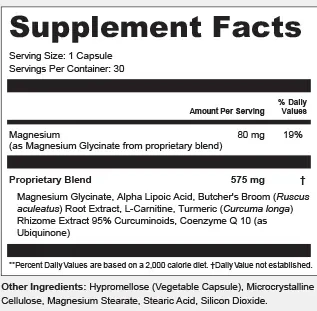
A proprietary blend must list its total weight and its ingredients from most to least, but not each amount (eCFR, 21 CFR 101.36). Synaptril's blend is 575 mg. The second ingredient holds at most half of that, the third at most a third, and so on.
Pure magnesium glycinate is about 14% magnesium, so 80 mg of magnesium needs about 570 mg of it (Magnesium glycinate, Mg content). That leaves about 8 mg for the other five.
Some magnesium glycinate is buffered and carries more magnesium. At 20%, the glycinate would weigh 400 mg and the other five would share at most 175 mg. The 20% figure is our assumption, not a published number.
The worked table sits on the Supplement Facts page.
Hard lines05
What will you never read on our pages?
You will never read a health promise the evidence does not support, a review we cannot verify, or a price we did not see on the sales page.
The bottle's three claims appear only in quotation marks with their asterisk, such as "Advanced Brain Support*". The FDA does not approve supplements before they are sold (FDA, Dietary supplements Q and A), so we never call the product approved.
The seller's brief included a sample score, order counts and named reviewers. We left all of it out. The FTC's 2024 rule bans reviews from people who do not exist or never used a product (FTC, Fake reviews final rule).
No page will ever tell you to stop or change a prescription for a supplement. If memory changes are new or getting worse, see a doctor first.
Disclosure06
Do we accept free products or payment for reviews?
No outside brand pays us to write about it. Getsynaptril does earn money when you order Synaptril through our links, and we say so plainly.
That tie is why the rules above exist. A seller has a reason to oversell, so we put the weak spots next to the strengths. Other brands are described from their own public labels, with no prices.
Accuracy07
Who checks articles for accuracy?
The Synaptril label desk checks every page against the label and the cited sources. A named medical reviewer has not been confirmed yet, and we do not claim one.
The byline box shows a reviewer slot. It stays blank until a qualified person has actually read the page.
Label check
Each fact about the capsule is matched to the label, word for word.
Source check
Each health line is matched to its cited source.
Claim check
Banned phrases and unverified figures are removed.
More about who runs the site is on the about page.
Corrections08
How often are articles updated, and how do we fix mistakes?
Articles are updated whenever the label, the sales page or a cited source changes. These pages were last checked October 18, 2026.
To report an error, write to [email protected] (Mon-Fri 9:00am-5:00pm ET) with the page and the line. We check it, fix it if we were wrong, and change the date. Order questions go to +1 (323) 348-1373, because the website inbox cannot see orders. Quality notes are on testing and quality.
Three sources behind our blend and grading rules
- 21 CFR 101.36, Nutrition labeling of dietary supplements. Electronic Code of Federal Regulations (FDA regulation), 2026.Under 21 CFR 101.36(c), dietary ingredients in a proprietary blend that lack a Daily Value are declared in descending order of predominance by weight. The quantitative amount listed for the blend is the total weight of those ingredients in the blend. The text requires the total and the order, not a separate weight for each such ingredient.
- Alpha lipoic acid for dementia. Sauer J, Tabet N, Howard R; Cochrane Database of Systematic Reviews (abstract via Europe PMC), 2004.The Cochrane review searched for double-blind, randomized, placebo-controlled trials of alpha-lipoic acid in dementia and found no trials that met its criteria. With no such trials, there is no evidence on the effects of alpha-lipoic acid in dementia. The authors concluded it cannot be recommended for people with dementia until trial data are available.
- Coenzyme Q10 and Cognition: A Review. Nankivell MC, Rosenfeldt F, Pipingas A, Pase MP, Reddan JM, Stough C; Nutrients, 2025.The review identified eight human clinical trials of CoQ10 and cognition, two in healthy people and six in people with disease. Four of the eight reported a benefit on cognition and two reported increased cerebral blood flow, while others found no cognitive benefit. The authors attribute the mixed results to differences in testing methods and in the bioavailability of CoQ10 preparations, and say more research is needed.
FAQ09
Questions about our editorial standards
How do we handle conflicting information about a product?
The printed label wins. If the sales page or the seller's brief says something different, we follow the label and note the gap. The label names Gluco Elixir as distributor while the sales-page footer names SHIPOFFERS, so we show both and do not guess further.
Why don't you print exact amounts for the blend ingredients?
Because the label does not give them, and any single number would be invented. We print upper limits instead. In the generous case, the five ingredients after magnesium glycinate share at most 175 mg; if the glycinate is pure, they share about 8 mg.
Why are there no star ratings on the site?
No buyer review has been matched to a real order yet. The figures in the seller's brief were sample copy, not verified customers, so we left them out. Reviews will appear only after each one is checked against an order, with the buyer's consent.
Is the medical reviewer named on these pages?
Not yet. The byline box holds a reviewer slot that stays empty until a qualified person actually reviews a page. We do not borrow a name from the seller's brief, and we never label a page as reviewed by a doctor when it was not.
Does earning commission change what you write?
It is the reason we write with hard rules. We earn money from order links, so pages also list the weak spots: no product trial, hidden blend amounts, little room for the five smaller ingredients and possible drug interactions. You can check every number yourself.
Can I use your evidence grades for other supplements?
Yes, as a rough guide. Ask whether people were studied, how many trials agree, and whether the studied dose matches the label. The FTC says the product advertised should match the dose and form that was studied (FTC, Health Products Compliance), a useful test for any bottle.
Who wrote this10
Written and reviewed by
Pages built from the label, the sales page and linked NIH, FDA, CDC, FTC and peer-reviewed sources.
Last updated . See our editorial standards and how we check reviews. This website is run by Getsynaptril, a stocked U.S. Synaptril counter, not by the manufacturer or the distributor. We are paid when you buy through our order links.
Keep reading
More Synaptril pages
Stocked U.S. Synaptril counter
Ready to try Synaptril?
Check your medicines first, then pick a pack. Three or six bottles ship free and cost less per bottle, and every pack carries the 60-day money-back guarantee.
- Secure BuyGoods checkout
- 60-day money-back guarantee
- Ships from the U.S.